
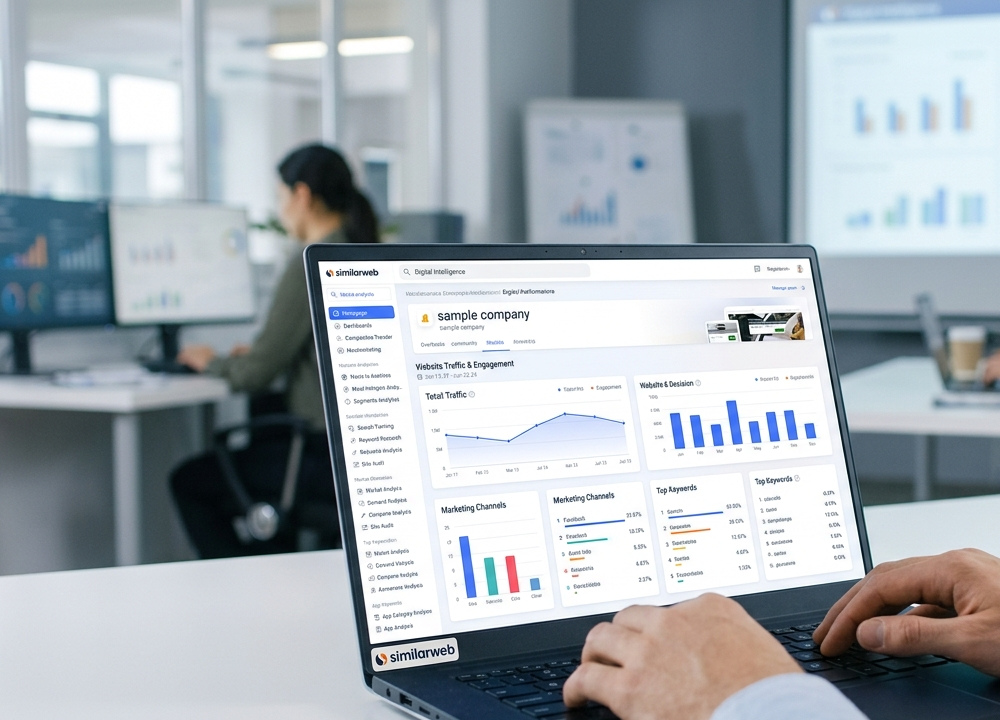
Understanding how websites attract visitors is essential for SEO, digital marketing, and competitive research. Similarweb is a digital intelligence platform that helps users study website traffic, search behavior, audience trends, competitors, and market opportunities. Its current platform combines web, app, marketplace, and search insights, giving businesses a broader view of digital performance.
This guide explains what Similarweb is, how it works, its main features, practical uses, limitations, and how beginners can turn its data into useful marketing decisions.
What Is Similarweb?
Similarweb is a digital intelligence and market research platform designed to help users understand how websites and digital businesses perform. It can provide insights into traffic, engagement, marketing channels, keywords, competitors, audience behavior, and market trends. The platform is particularly useful when you want to research a website you do not control. Unlike first-party analytics, which show detailed data from your own property, Similarweb provides an external view that can help you benchmark competitors and understand a broader market.
How Does Similarweb Work?
The data behind the platform is built from several sources rather than one tracking method. According to its methodology documentation, these include direct measurement, a contributory network, partnerships, and public data extraction. The company then processes and models those signals to create digital intelligence estimates. This distinction matters because the platform is not a replacement for your own analytics. Its value comes from making comparable market and competitor insights available across digital properties.
Website Traffic Estimation
Traffic estimates can help answer questions such as:
- How much attention does a website appear to receive?
- Is its traffic growing or declining?
- Which channels contribute to visits?
- How does it compare with competing websites?
Search and Keyword Data
Search research is another important part of the platform. Its keyword analysis can show search volume, search visits, CPC, positions, landing pages, and competitive traffic information. This makes the tool useful for SEO professionals who want to move beyond rankings and understand the traffic potential behind a search term.
Key Similarweb Features
The platform has a wide range of features, but most users can organize them into a few practical areas.
Website Traffic Analysis
Website analysis helps you investigate traffic and engagement for a domain. Depending on the available report and access level, users can examine visits, engagement, traffic sources, rankings, keywords, referrals, and advertising information. A useful approach is to look for patterns instead of focusing on one number. A competitor with more visits is not automatically more successful if its audience is poorly matched to its business goals.
Traffic Source Analysis
Traffic source analysis helps reveal how visitors reach a website. Common categories include:
- Direct
- Organic search
- Paid search
- Referrals
- Social
- Display advertising
Keyword Research
The platform can support both SEO and paid search research. Its keyword analysis is designed to examine the competitive landscape for a search term and can include search volume, traffic, CPC, positions, and related landing pages. This can help you prioritize keywords based on actual traffic opportunities rather than search volume alone.
Audience and Market Insights
Audience and market data can help businesses understand where demand is coming from and which digital properties matter within a category. This is especially useful for market sizing, competitor benchmarking, expansion research, and campaign planning.
App and Digital Intelligence
The current platform also covers web, app, and marketplace insights, allowing organizations to examine more than traditional desktop website traffic. Its All Traffic approach combines desktop and mobile web activity into a unified view rather than simply adding the two figures together.
How to Use Similarweb for Competitor Research
A good competitor analysis should begin with a clear question rather than random browsing.
Choose Relevant Competitors
Start with three to five websites that compete for the same audience, search demand, or market. Direct competitors are useful, but indirect competitors can also reveal new opportunities.
Compare Traffic and Engagement
Look at traffic trends and engagement metrics together. Avoid assuming that the largest traffic number automatically represents the strongest business.
Study Traffic Channels
Find out whether competitors appear to rely more heavily on search, referrals, social, paid campaigns, or direct traffic. This can reveal where your market is investing.
Investigate Keywords
Review important keywords and landing pages. Search data can show which terms send traffic and which competitors are capturing demand.
How to Use Similarweb for SEO
SEO teams can use Similarweb as a competitive research layer alongside tools such as Google Search Console and first-party analytics.
Find Competitor Keywords
Look for keywords that generate meaningful search visits to competing sites. Do not target every keyword you find. Filter opportunities by relevance, intent, competition, and your ability to create a better result.
Discover Content Gaps
If several competitors receive traffic for related topics that your site does not cover, those subjects may represent content opportunities.
A useful workflow is:
- List your main competitors.
- Identify their important search topics.
- Group related keywords by search intent.
- Compare them with your existing content.
- Create or improve pages where there is a genuine audience need.
Study Search Trends
Search data can help you identify changes in demand. Similarweb says its newer Search 3.0 data combines real-user and SERP data and offers daily recalibration, long-tail keyword coverage, and recent trend views.
Similarweb for Digital Marketing
Digital marketers can use the platform to understand how acquisition channels differ across competitors.
Improve Channel Strategy
If competitors appear to receive substantial traffic from a channel you barely use, investigate why before investing. The data should generate a hypothesis, not automatically dictate your budget.
Research Paid Search
Keyword and advertising insights can help reveal areas where competitors are active. You can then evaluate whether those terms align with your products, margins, and customer intent.
Understand Social Traffic
Social traffic patterns can reveal which platforms deserve closer attention. However, a high percentage of social traffic does not guarantee strong conversions, so always connect external research with your own business results.
Benefits of Similarweb
Better Competitive Visibility
One of the biggest advantages is the ability to research competitors and markets from an external perspective.
Faster Market Research
Instead of collecting scattered information manually, marketers can investigate traffic, search, audience, and competitor signals within one research environment.
Stronger SEO Planning
Keyword and traffic insights can help content teams find topics, competitors, and opportunities worth investigating.
Traffic Data Is Estimated
Similarweb explains that its estimates will not necessarily align exactly with direct measurement data such as Google Analytics. Different methodologies, time periods, devices, and metrics can produce different numbers.
Small Websites May Have Limited Data
Smaller sites may have less reliable or less complete estimates. The company specifically notes that limited results can occur when a site does not have sufficient traffic or coverage.
Data Needs Context
A traffic estimate without context can be misleading. Always consider the period, country, device mix, traffic source, and metric being compared.
Similarweb vs Google Analytics
Google Analytics is a first-party analytics platform for websites and apps you control. Similarweb is primarily useful for external digital intelligence and competitive research.
The simplest distinction is:
| Tool | Main Purpose | Best Use |
| Similarweb | External digital intelligence | Competitor and market research |
| Google Analytics | First-party measurement | Analyzing your own website |
| Google Search Console | Search performance | Queries, clicks, impressions, indexing |
| SEO platforms | Search and competitive research | Keywords, backlinks, content planning |
Best Practices for Using Similarweb
Start With a Specific Question
Before opening reports, decide what you want to learn. For example: “Which channels are driving growth for our three main competitors?”
Compare Multiple Websites
A single competitor can produce misleading conclusions. Comparing several relevant sites helps reveal broader patterns.
Verify Important Findings
If a finding could affect a major investment, confirm it with your own analytics, Search Console, keyword research, customer data, or another reliable source.
Common Mistakes to Avoid
Treating Estimates as Exact Numbers
External traffic intelligence is different from first-party measurement. Use the numbers directionally and compare like-for-like metrics.
Copying Competitors
Competitor data should inspire research, not imitation. Your audience, product, brand, and resources are different.
Looking Only at Traffic
Traffic volume is only one part of digital performance. Engagement, audience quality, conversions, revenue, and intent matter too.
Who Should Use Similarweb?
SEO Professionals
SEO specialists can use it for competitor keywords, search trends, traffic research, and content opportunity discovery.
Digital Marketers
Marketing teams can use it to investigate acquisition channels and competitive positioning.
Business Owners
Owners can use market intelligence to understand competitors and explore new opportunities.
Agencies
Agencies can use competitive research to support strategy development and client reporting.
How to Get the Most Value From Similarweb
The best results come from combining external research with first-party evidence. Start by defining a business question. Select relevant competitors. Examine traffic and search trends. Identify gaps. Then validate the most important findings with your internal data. For example, if competitor research suggests that organic search is a major growth channel, check your own Search Console data to see whether related queries are already generating impressions. If there is demand but weak visibility, that may be a stronger opportunity than simply copying a competitor’s top page.
Conclusion
Similarweb is valuable because it helps turn the web’s scattered signals into a clearer picture of digital competition. It can support website traffic analysis, competitor research, SEO planning, keyword discovery, market research, and marketing strategy. The most important lesson is to use the platform thoughtfully. Its estimates should not be confused with first-party analytics, and a single traffic number should never determine a major business decision. Instead, compare relevant competitors, study trends, investigate the reasons behind changes, and validate important findings with your own data.
FAQs
Q1: What is Similarweb?
Ans: Similarweb is a digital intelligence platform that provides insights into website and app performance, traffic sources, search behavior, competitors, audiences, and markets. It is especially useful for external competitive and market research.
Q2: What is Similarweb used for?
Ans: It is commonly used for website traffic analysis, competitor research, keyword research, market intelligence, audience analysis, and digital marketing planning.
Q3: Is Similarweb accurate?
Ans: Similarweb provides estimated data, so its figures may differ from first-party analytics. The company explains that its methodology uses multiple data sources and that smaller sites can have more limited results. Important decisions should be supported by additional evidence.
Q4: Can Similarweb analyze competitor websites?
Ans: Yes. Competitor analysis is a major use case. You can compare websites, traffic sources, search performance, rankings, and other digital signals to understand competitive positioning.
Q5: Can Similarweb help with SEO?
Ans: Yes. Its search and keyword features can help identify search demand, competitor keywords, traffic-driving terms, landing pages, and content opportunities.