
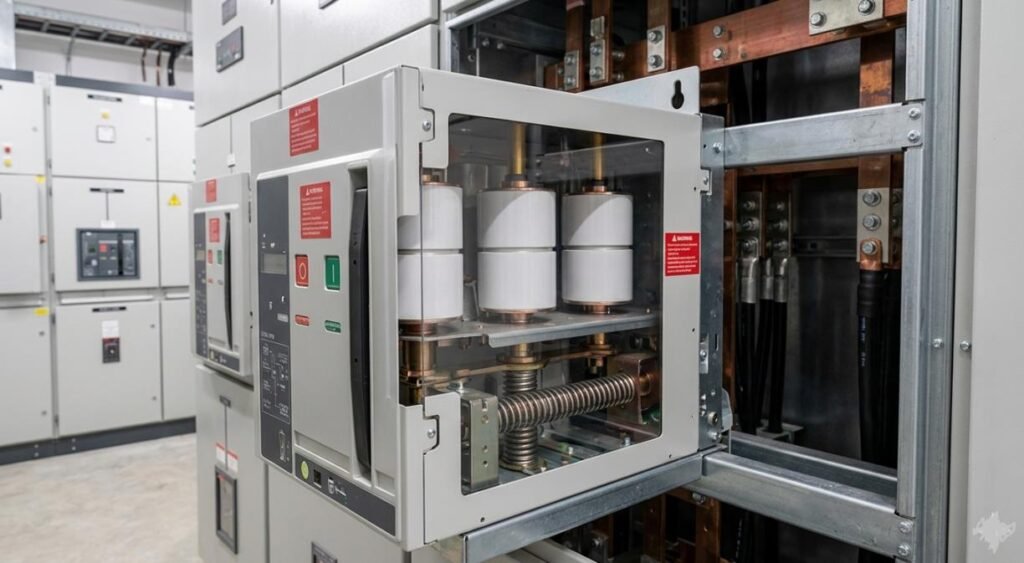
Modern electrical systems require reliable protection equipment to maintain safety, efficiency, and uninterrupted power supply. One of the most widely used protective devices in medium-voltage power systems is the vacuum circuit breaker. It is designed to interrupt electrical faults and prevent damage to transformers, generators, cables, and other electrical equipment.
A vacuum circuit breaker has become highly popular because of its fast operation, low maintenance, compact design, and environmentally friendly performance. Unlike oil circuit breakers or air circuit breakers, it uses vacuum as the arc quenching medium, which makes the interruption process more efficient and safer.
Vacuum circuit breakers are commonly installed in power distribution networks, industrial plants, substations, renewable energy systems, and railway electrification projects. Their reliability and long service life make them a preferred choice for modern electrical protection systems.
What Is a Vacuum Circuit Breaker?
A vacuum circuit breaker (VCB) is an electrical switching device used to protect power systems by interrupting fault currents under vacuum conditions. It operates by separating electrical contacts inside a sealed vacuum chamber whenever a fault occurs.
The vacuum inside the interrupter acts as an excellent insulating medium because it contains no ionized particles. When the contacts separate, the arc formed between them is quickly extinguished due to the high dielectric strength of the vacuum.
Vacuum circuit breakers are generally used for medium-voltage applications ranging from 3.3 kV to 36 kV. They are widely preferred in modern substations because they require very little maintenance and provide consistent performance.
Read More: Samsung Galaxy S24 Ultra Review – Features, Camera, Battery & Performance
Working Principle of Vacuum Circuit Breaker
When the circuit breaker is in the closed condition, the current flows normally through the fixed and moving contacts. During a fault condition such as a short circuit or overload, the protection relay sends a signal to open the breaker contacts.
As the contacts begin to separate, an electric arc is formed due to the ionization of metal vapors released from the contacts. However, since the contacts are placed inside a vacuum chamber, the arc cannot sustain for a long period.
At the natural current zero point, the metal vapor condenses rapidly, and the dielectric strength of the vacuum recovers quickly. This process extinguishes the arc and interrupts the fault current safely.
Main Components of Vacuum Circuit Breaker
A vacuum circuit breaker consists of several important components that work together for safe current interruption.
- Vacuum Interrupter: The vacuum interrupter is the heart of the circuit breaker. It contains fixed and moving contacts enclosed in a sealed vacuum chamber.
- Fixed Contact: The fixed contact remains stationary and allows current flow during normal operation.
- Moving Contact: The moving contact opens and closes during breaker operation to interrupt fault current.
- Arc Shield: The arc shield protects the vacuum chamber from metal vapor deposition during arc formation.
- Operating Mechanism: The operating mechanism controls the opening and closing action of the breaker. It may use spring, hydraulic, or magnetic energy.
- Insulation System: The insulation system isolates live components and ensures operator safety.
Construction of Vacuum Circuit Breaker
The vacuum chamber is made of ceramic or glass material and contains metallic contacts. The contacts are specially designed to withstand repeated switching operations. A metallic bellows arrangement is used to allow the moving contact to move without breaking the vacuum seal.
The interrupter assembly is mounted on a support structure connected to the operating mechanism. The entire system is designed to ensure smooth operation, electrical insulation, and mechanical durability.
How Arc Extinction Works in Vacuum Circuit Breaker
When the breaker contacts separate, an arc forms due to metal vapor ionization. However, because the vacuum contains very few particles, the arc cannot continue for long. As the alternating current approaches zero, the ionized metal vapor rapidly condenses on the contact surfaces.
This increases the dielectric strength of the vacuum quickly and stops the arc permanently. The vacuum interrupter regains insulation strength almost immediately, preventing restriking of the arc. This efficient arc extinction process is the main reason why vacuum circuit breakers are highly reliable in medium-voltage systems.
Types of Vacuum Circuit Breakers
Vacuum circuit breakers are classified based on their installation and application.
Indoor Vacuum Circuit Breaker: Indoor VCBs are installed inside buildings and control rooms. They are commonly used in factories, commercial buildings, and substations.
Outdoor Vacuum Circuit Breaker: Outdoor VCBs are designed for external installations and can withstand environmental conditions such as rain, dust, and temperature changes.
Fixed Type Vacuum Circuit Breaker: In fixed type VCBs, the breaker remains permanently installed in the switchgear panel.
Draw-Out Type Vacuum Circuit Breaker: Draw-out VCBs can be easily removed from the panel for inspection and maintenance.
Advantages of Vacuum Circuit Breaker
Vacuum circuit breakers offer several benefits over conventional circuit breakers.
High Reliability: VCBs provide reliable fault interruption with minimal risk of failure.
Low Maintenance: Since there is no oil or gas handling, maintenance requirements are very low.
Long Service Life: The contacts experience very little wear, resulting in a longer operational life.
Compact Design: The breaker occupies less space compared to other circuit breaker types.
Fast Arc Extinction: Vacuum provides rapid dielectric recovery, ensuring quick interruption.
Environmentally Friendly: VCBs do not use harmful gases like SF6, making them eco-friendly.
Low Fire Risk: The absence of oil eliminates the possibility of fire hazards.
Disadvantages of Vacuum Circuit Breaker
Despite many advantages, vacuum circuit breakers also have some limitations.
Higher Initial Cost: The manufacturing cost of vacuum interrupters is relatively high.
Limited Voltage Range: VCBs are mainly suitable for medium-voltage applications.
Complex Manufacturing Process: Producing vacuum interrupters requires specialized technology and precision.
Current Chopping: In some cases, interruption of low inductive current may cause voltage surges.
Applications of Vacuum Circuit Breaker
Vacuum circuit breakers are widely used in various industries and electrical systems.
Power Distribution Systems: VCBs are extensively used in medium-voltage power distribution networks.
Industrial Plants: Factories and manufacturing plants use vacuum circuit breakers for motor and equipment protection.
Electrical Substations: Substations rely on VCBs for reliable switching and fault isolation.
Renewable Energy Systems: Solar and wind power plants use VCBs for electrical safety and switching operations.
Railway Electrification: Railway systems use vacuum circuit breakers for traction power distribution.
Commercial Buildings: Large commercial complexes use VCBs in electrical panels and switchgear systems.
Vacuum Circuit Breaker vs SF6 Circuit Breaker
The following table compares vacuum circuit breakers and SF6 circuit breakers.
| Feature | Vacuum Circuit Breaker | SF6 Circuit Breaker |
| Arc Quenching Medium | Vacuum | SF6 Gas |
| Maintenance | Low | Moderate |
| Environmental Impact | Eco-Friendly | Harmful Greenhouse Gas |
| Fire Risk | Very Low | Low |
| Dielectric Recovery | Fast | Moderate |
| Cost | Medium | High |
| Voltage Range | Medium Voltage | High Voltage |
| Service Life | Long | Long |
| Installation | Compact | Larger Size |
| Operating Reliability | Excellent | Excellent |
Maintenance of Vacuum Circuit Breaker
Proper maintenance ensures reliable operation and long service life.
Visual Inspection: Inspect the breaker regularly for dust, damage, and loose connections.
Contact Wear Inspection: Check the condition of contacts and replace them if excessive wear is observed.
Mechanical Operation Testing: Test the opening and closing mechanism to ensure smooth operation.
Vacuum Integrity Test: Perform vacuum testing to verify the interrupter seal condition.
Lubrication: Lubricate moving mechanical parts according to manufacturer recommendations.
Safety Precautions for Vacuum Circuit Breaker
Safety is extremely important when working with electrical equipment.
- Disconnect power before maintenance
- Use protective equipment
- Follow lockout and tagout procedures
- Avoid unauthorized operation
- Perform regular inspections
- Use proper testing instruments
Future of Vacuum Circuit’s Breaker Technology
Modern electrical grids are moving toward automation and smart technologies. Vacuum circuit breakers are being integrated with digital monitoring systems for remote operation and fault analysis. Researchers are also developing advanced vacuum interrupters for higher voltage applications.
Improved materials and compact designs are making VCBs more efficient and reliable. As industries continue to focus on safety, energy efficiency, and environmental protection, vacuum circuit breakers will remain an important part of modern electrical infrastructure.
Why Vacuum Circuit’s Breakers Are Popular in Modern Industries
Industries today require uninterrupted power supply and dependable protection systems. Vacuum circuit breakers provide stable performance under demanding operating conditions. Their low maintenance requirement reduces operational costs significantly.
Unlike oil circuit breakers, there is no need for frequent oil replacement or gas monitoring. The compact size of VCBs also allows easier installation in limited spaces. These benefits make vacuum circuit,s breakers one of the most preferred choices in industrial and commercial electrical systems.
Conclusion
A vacuum circuit breaker is one of the most efficient and reliable protective devices used in modern electrical systems. Its ability to interrupt fault currents quickly under vacuum conditions makes it ideal for medium-voltage applications. The vacuum circuit’s breaker working principle is based on rapid arc extinction and fast dielectric recovery, which ensures safe and dependable operation.
Its compact design, low maintenance requirement, long service life, and environmental benefits have made it highly popular in industries, substations, and power distribution systems. As electrical infrastructure continues to advance, vacuum’s circuit breakers will continue playing a major role in ensuring safe and efficient power system protection.
FAQs
Q1. What is a vacuum circuit breaker?
Ans: A vacuum’s circuit breaker is an electrical switching device that interrupts fault current using vacuum as the arc quenching medium.
Q2. What is the working principle of a vacuum circuit breaker?
Ans: The breaker operates by separating contacts inside a vacuum chamber. The arc formed during separation is extinguished quickly due to the high dielectric strength of vacuum.
Q3. Where are vacuum’s circuit breakers used?
Ans: Vacuum circuit breakers are used in substations, industrial plants, commercial buildings, renewable energy systems, and power distribution networks.
Q4. What are the advantages of vacuum circuit breakers?
Ans: Major advantages include low maintenance, high reliability, compact size, fast arc extinction, long service life, and eco-friendly operation.
Q5. What is the voltage range of vacuum circuit’s breakers?
Ans: Vacuum circuit’s breakers are commonly used for medium-voltage applications ranging from 3.3 kV to 36 kV.
Q6. What is the difference between VCB and SF6 circuit breaker?
Ans: VCB uses vacuum for arc extinction, while SF6 circuit breakers use sulfur hexafluoride gas. VCBs are more environmentally friendly.
Q7. Why is vacuum used in circuit breakers?
Ans: Vacuum has excellent insulating properties and enables rapid arc extinction, making current interruption faster and safer.